
Tired of sterile white cabinets? You’re not alone. In 2023, wood-tone vanities quietly claimed the No. 1 spot from white—33 percent of renovators now choose wood while 29 percent still pick white Houzz 2023 U.S. Bathroom Trends Study.
Designers say the appeal runs deeper than color. “Homeowners are craving warmth and character,” notes interior designer Lexie Saine in a Livingetc interview, who sees clients trading light oak for richer walnut and mahogany finishes.
We’ll spotlight seven standout dark-wood vanities—ranked by build quality, design, features, and real-world value—so you can pick a piece that looks timeless today and still feels fresh years from now. Let’s dive in.
How to choose a dark-wood vanity
Picking a vanity is part style move, part engineering check. Nail both and you dodge swollen drawers, peeling veneer, and buyer’s remorse.

Start with the bones. We want solid hardwood frames (walnut, teak, mahogany, or a kiln-dried poplar at minimum). Plywood panels with real-wood veneer are fine because they stabilize wide surfaces so doors don’t warp. Skip raw particleboard—the first splash through a screw hole makes it puff up like a sponge.
Next, think about moisture defense. Teak’s natural oils rank it as the gold standard for wet rooms, while walnut’s dense grain resists fungus and cracking almost as well. Whatever species you choose, insist on a factory lacquer or conversion varnish that seals every surface, including drawer interiors.
Size and layout come next. Measure wall to wall, then subtract at least 2 inches for comfortable clearance. A 36-inch single fits most main baths, while a 60-inch double keeps peace in busy households. Floating models open floor space and make mopping easier, but they need solid wall blocking. If you can’t hit studs with every screw, add a hidden steel bracket.
Storage is where great vanities pull ahead. Full-extension dovetail drawers beat fixed shelves because they slide skincare into view rather than making you crouch. Integrated outlets are practical too—they let you charge toothbrushes with cords tucked away and counters clean.
Finally, test the finish color under your bathroom’s lights. Rich espresso reads almost black under LEDs, while classic walnut shows warm brown in daylight. Pair a dark base with a bright counter (white quartz or Carrara marble) to keep the room airy and showcase the wood’s depth.
Run through those checkpoints and you’ll land a piece that looks luxurious today and still closes softly a decade from now.
At-a-glance comparison
You asked for speed, so here it is. Scan the grid, spot the size you need, then jump to the individual reviews that follow.
| Model | Sizes (in.) | Primary wood & finish | Mount | Countertop included | Stand-out feature | Price (USD) |
| Willow Elizabeth | 24–84 | Solid teak, dark walnut stain | Freestanding | No | Outlet-ready drawer, dovetail joinery | 1,449–3,499 |
| Allen + Roth Rian | 30–48 | Hardwood frame, walnut veneer | Freestanding | Yes (cultured marble) | Open shelf keeps rooms airy | 699–1,199 |
| West Elm Mid-Century | 36 | Eucalyptus frame, walnut veneer | Legged | Optional | Iconic tapered legs, mid-century vibe | 1,399 (base) |
| Signature Hardware Thornton | 48 / 60 | Solid mahogany, espresso finish | Freestanding | Yes (Carrara marble) | Tip-out trays plus full drawers | 1,949–2,599 |
| James Martin Brookfield | 26–72 | Poplar frame, mahogany veneers | Freestanding | Optional | Heirloom-quality details | 1,765–3,554 |
| Native Trails Topanga | 30–48 | Solid walnut, low-VOC finish | Floating | No | Mid-century modern design | 2,059–4,606 |
| Restoration Hardware St. James | 60 / 72 | Solid oak, antiqued walnut stain | Freestanding | No | Furniture-grade luxury | 4,895+ |
We ranked these seven on build quality, design, features, value, durability, and sustainability. Use the sheet as a quick filter, then let the detailed rundowns explain why each one earned its place.
1. Willow Bath & Vanity – Elizabeth teak collection
If you want a vanity that feels custom built yet ships ready to slide into place, start here. Willow’s Elizabeth cabinet is crafted from solid teak and stained a deep walnut brown that lets the tight grain glow instead of hide.
Teak earns its “gold standard” label for wet rooms because natural oils shrug off humidity, steam, and the occasional toddler water fight, according to Ashdeco’s driftwood vanity guide. That resilience keeps drawers square, doors aligned, and panels unswollen five winters in.
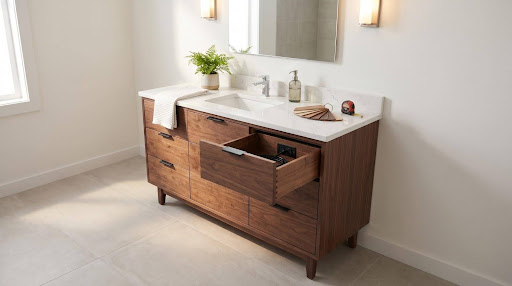
Open the top drawer and you’ll spot the extras that lift this piece above big-box rivals. A built-in power strip sits beside a fitted hair-dryer holster, so cords disappear and countertop clutter follows. Every drawer rides on full-extension, soft-close glides and is finished inside and out, so even cotton rounds land on a smooth, sealed surface.
The cabinet ships without a counter, which is a plus. Pair the dark base with bright quartz for contrast or choose veined marble that echoes other stone in your bath. Willow Bath and Vanity offers the Elizabeth in widths from a space-saving 24 inches up to an 84-inch double, covering powder rooms through primary suites.
Value clinches its top rank. At about $1,500 for the 24-inch model, you pay mid-tier pricing for furniture-grade joinery, FSC-certified wood, and that hidden-outlet convenience. Installation feels like setting a dresser in place: level it, secure to studs, hook up plumbing, and enjoy drawers that close with a hushed sigh.
2. Allen + Roth – Rian walnut vanity
Good design on a starter budget is rare, yet the Rian line hits the bull’s-eye. Lowe’s house brand frames the cabinet in solid hardwood and wraps the side panels in walnut veneer sealed front and back. The result looks custom even though it rolls off a factory line.
Straight from the carton you get a white cultured-marble top, an undermount sink, and pre-drilled faucet holes. That bundle saves a weekend of shopping and a few hundred dollars on stone fabrication.
Practical touches matter more than price. Rian stands on chunky legs, so moisture never pools against a raw edge. Soft-close hinges stop door slam, and the slatted shelf airs towels instead of trapping humidity. Owners love the open shelf because it makes small baths feel wider.
Installation stays DIY-friendly. The back arrives partially open, giving supply lines plenty of wiggle room. Level the legs, drive two screws into studs, silicone the top, and you’re brushing your teeth in style before lunch.
All that lands under $800 for the 36-inch size. For renters, first-time renovators, or guest baths that deserve better than particleboard, Rian is the easiest yes on this list.
3. West Elm – Mid-Century walnut vanity
Picture Don Draper’s sideboard, scaled for a powder room. West Elm’s mid-century cabinet nails the blend of retro charm and modern function with its signature splayed legs and warm walnut veneer.
Those legs do more than look good. By lifting the box off the floor they reveal extra tile, so small baths feel larger. Underneath, adjustable levelers tame uneven floors—an often skipped detail in fashion-first furniture.
Inside, the layout is smart. Two drawers on the left glide full-extension, dodging plumbing with a neat U-shaped cut-out so you still get usable depth. On the right, a hinged door hides taller bottles behind a clean slab front. Every moving part closes softly, ending with a quiet click.
West Elm sells the cabinet solo or pre-paired with a slim ceramic or marble top. Cabinet-only lets you choose a bold quartz slab, but if speed matters, the kit version bolts on in minutes.
Build quality lands in the mid-premium tier: a solid eucalyptus frame for strength, real walnut veneer for beauty, and a hand-applied lacquer that shrugs off splashes when you forget to wipe down. For about $1,000, it delivers a designer look that feels truly timeless.
4. Signature Hardware – Thornton mahogany vanity
Need serious storage without tipping into hotel-buffet proportions? Thornton delivers. The 48-inch footprint (60-inch double also available) houses six soft-close spots: two flip-down trays up top, three center drawers, and twin side cabinets, so everyone’s toiletries finally get their own lane.
Signature Hardware frames the piece in solid mahogany, a hardwood prized for rot resistance and dimensional stability. The espresso finish leans almost black in evening light, yet subtle red-brown undertones appear when morning sun pours in, adding depth you never see in sprayed-on espresso laminates.
The package includes a polished Carrara marble top, pre-drilled and bonded to the base. That bundle saves the hassle of finding a fabricator and keeps the total cost under $2,000, impressive when marble alone can reach four figures.
Installers praise Thornton’s fully open back and sturdy leveling feet. Set it against the wall, shim for plumb, anchor through the hidden rail, and you’re done. The weighty stone top means you’ll want a helper, but once settled, the vanity feels as solid as built-in cabinetry.
A final grace note: those slim tip-out trays. They corral toothpaste tubes and contact-lens cases—items that usually clutter the counter—so the marble stays photo-ready with almost zero effort.
5. James Martin – Brookfield burnished-mahogany double
Brookfield sits in the “buy it once, love it forever” tier. James Martin builds the cabinet like heirloom furniture: poplar solids and veneers, English dovetail joinery, and a hand-stained burnished mahogany finish that glows deep and warm.
At 72 inches wide, the double-sink layout ends the morning elbow war. Four doors hide roomy base compartments, while three dovetailed center drawers handle hair tools, skincare bottles, and spare towels. Open the cabinet and you’ll find a power strip with USB and standard outlets, making countertop chargers vanish.
James Martin sells the base with multiple top options, but most buyers choose polished white Carrara to sharpen the contrast against the dark wood. The combination feels boutique-hotel luxe without tipping into gaudy.
You’ll spend about $4,000 once the stone arrives, yet the value still works. Brookfield feels like custom millwork, installs in a day, and—thanks to its classic lines—won’t look dated when trends shift.
6. Native Trails – Topanga walnut floating vanity
If sustainability sits high on your checklist, Topanga lets you remodel with a clear conscience. Each cabinet is handcrafted in Eastern Europe from FSC-certified solid walnut, supporting responsibly managed forests.
Native Trails seals the rich grain in a matte, low-VOC finish that protects against bathroom humidity while still feeling like raw wood to the touch.
Topanga floats on an integrated French cleat, visually freeing floor space and making small baths feel spa-like. A deep drawer glides on soft-close, full-extension slides and is fully lined in walnut, so the mid-century exterior matches a refined interior.
Because the wood is natural, no two vanities share the same grain or knot pattern. That one-of-a-kind character, paired with third-party FSC verification, justifies the $2,000 to $4,600 price range.
Choose Topanga if you want your bathroom to whisper luxury while speaking loudly about eco credentials.
7. Restoration Hardware – St. James antiqued-walnut vanity
St. James is the vanity that prompts real-estate agents to use the phrase “furniture grade.” Carved from solid American oak and finished in an antiqued walnut stain, it feels like a nineteenth-century sideboard quietly repurposed for plumbing.
Open a drawer and you’ll find dovetails thick enough to survive generations. Brass knobs arrive with a living finish that will patina alongside the wood, reinforcing the heirloom vibe. Even the back panels are oak, not thin hardboard, so the cabinet stays rigid when a stone top adds 200 pounds of load.
Countertops are sold à la carte: polished Carrara, honed Calacatta, or cast concrete slabs all drop straight in. The combination pushes the total above $5,000, but it also lets you curate a surface that matches your exact tile and fixture palette.
Installation demands muscle and planning. At 60 inches wide and more than 300 pounds once topped, St. James is a two-person lift. Secure blocking in the wall, use wide washer-head screws through the hidden rail, and the vanity will sit as solidly as built-ins.
St. James is about permanence. Buy it, maintain the finish with a yearly coat of furniture wax, and future home buyers will thank you with a higher offer.
Caring for your dark-wood vanity
A quality vanity is half purchase, half partnership. Treat the wood well and it will reward you with decades of rich color and smooth-closing drawers.
Wipe splashes the same day you see them. Water left overnight seeps into grain ends and lifts even the best finish. A quick swipe with a microfiber cloth keeps edges tight and stain lines crisp.
Once a month, clean with a mild dish-soap solution: 5 drops in 1 quart of warm water. Skip bleach and ammonia; both strip protective lacquer and dull the sheen.
High humidity is the silent killer, so run the exhaust fan for 10 minutes after every shower. If your bath lacks ventilation, crack the door or place a silent mini-dehumidifier under the sink.
Re-seal marble tops annually to protect the wood below. Drips of etching cleaner can migrate through seams; a fresh coat of stone sealer blocks the path.
Twice a year, feed the finish. A thin layer of furniture wax or lemon oil buffs out micro-scratches and keeps darker tones from looking chalky. Work in small circles, let haze, then buff until the cloth slides.
Dark-wood vanity FAQ
Will a dark vanity make my small bathroom feel cramped?
Not if you manage contrast and lighting. Pair a walnut cabinet with bright walls, mirror it across generous task lighting, and the dark tone becomes a statement, not a shadow. Floating models expand visible floor area, helping the room read as larger.
Is solid wood really better than MDF in a humid room?
Yes. Hardwoods such as teak and mahogany contain natural oils that resist swelling, while MDF fibers absorb moisture and expand. Over time, that difference decides whether you tighten a hinge or replace an entire cabinet.
Do dark finishes show dust and water spots?
Only on slick, high-gloss lacquers. The vanities we chose use satin or matte topcoats that blur fingerprints. Keep a microfiber cloth in the top drawer; a 10-second wipe leaves the surface immaculate.
How often should I reseal the wood?
Most factory finishes last years without extra coats. Focus on prevention instead: wipe standing water daily and maintain bathroom ventilation. If the sheen dulls after a few years, a single layer of furniture wax restores depth.
What’s the easiest way to hide cords?
Look for vanities with integrated outlets inside a drawer (Willow and James Martin both include this feature). Your toothbrush, razor, and hair tools stay charged yet invisible.
Can I retrofit an outlet into a vanity that doesn’t have one?
Absolutely. A licensed electrician can run a GFCI-protected line into a drawer box for about $200. It’s a quick upgrade that boosts convenience and resale value.
How do I ensure a floating vanity stays rock solid?
Mount it to wall studs with the manufacturer’s steel bracket, add blocking if studs don’t line up, and use structural screws. When in doubt, hire a professional; correcting a sagging cabinet costs more than installing it right the first time.