

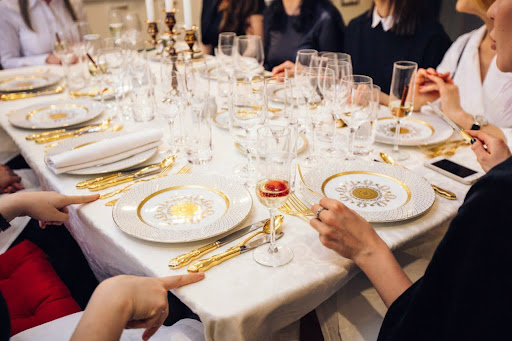
Currently, traditional European dining etiquette continues to serve as a marker of social status, personal upbringing, and the cultural values of one’s community. At the same time, such an exclusive tablescape reveals a refined personality, impeccable taste, and a lifestyle philosophy centered on slow luxury and bon vivant values. In everyday life, it’s rarely easy to create an elegant table, yet for those who treat dining as a daily ritual, following the traditional rules and details transforms an ordinary dinner into a refined experience. The luxury décor and tablescape experts at MDMAISON shared their insight into modern dining traditions—and curated a stunning four-course table concept sure to impress every guest.
Destinations Where Dining Etiquette Is a Must
So, where can you still find a truly classic table setting today? These are the places where refined rituals are a must, and showing up polished and properly dressed is simply expected.
- In aristocratic families across Europe—France, Belgium, Italy—or within the luxury circles of Dubai, London, and Geneva, it’s common to maintain a household staff dedicated solely to the art of table setting and presentation. In such homes, it’s a tradition to come together at least once a day in a formal dining room, enjoying a beautifully arranged meal that celebrates refined taste and timeless elegance.
- Haute cuisine and fine dining locations, including Michelin-starred restaurants and private dining clubs, continue to support traditional French service, where cutlery is replaced between courses and glasses are carefully selected for each type of wine.
- At embassy and diplomatic receptions, classic etiquette is a necessary part of protocol. From seating order to the sequence of courses, every glass and piece of cutlery is placed with precision.
- Luxury hotels and residences continue to honor guests with refined table settings. At renowned destinations such as the Four Seasons, Ritz Paris, Mandarin Oriental, and The Dorchester, table arrangements follow classical etiquette, both in fine dining or degustation evenings, but also within luxury suites for their VIP guests.
- On luxury yachts worth millions, adherence to formal table service and dining etiquette remains a standard requirement, ensuring consistency with high-end hospitality traditions. Every yacht crew undergoes training in the art of elegant entertaining so that both guests and owners can enjoy the same atmosphere of sophistication and comfort they expect on land, even while sailing.
- Prestigious hunting lodges, inheriting the legacy of European seasonal culture, curate evenings marked by visual refinement and a strict compliance with formal etiquette. There, the serving of games at lunch turns into a true event—a celebration of tradition, craft, and taste.
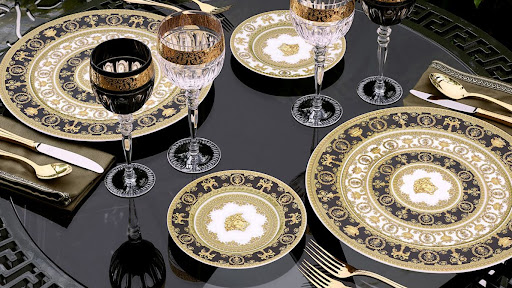
Dining Etiquette Traditions Around the World
France remains the homeland of tradition, where dining etiquette is treated as an art passed down through generations. The art of dining is rooted in beauty and appreciation. They eat slowly, really tasting everything and chatting along the way, because it’s all about respect and pleasure. They’ve got their own rules: bread goes straight on the table, not on a plate, and cheese and dessert always come separately, each with its own little setup.
In Italy, dining is considered an integral part of daily life and a reflection of national identity. Italians love to talk over their meals, taking their time and letting each flavor stand on its own. They carefully monitor the presentation of dishes and ensure that each course is accompanied by the appropriate alcoholic beverage, frequently changing glasses, plates, and cutlery throughout the meal.


In Germany, structure and etiquette go hand in hand. Guests take their seats only after the host’s invitation and begin dining strictly when the signal is given. In Germany, people stick to using each utensil exactly how it’s meant to be used—and they hardly ever put the knife down. Leaving food on your plate looks rude, so portions tend to be on the smaller side.
The Brits are all about manners and control at the table—you keep your fork in your left hand, your knife in your right, and you never, ever drop your utensils on the table while eating. And, of course, tea is a ceremony of its own in Britain.
General Principles of European Dining Etiquette
European table manners are basically a whole system built around being polite and knowing how to behave neatly and respectfully at the table. It took shape in the medieval courts and, to this day, remains the benchmark of good manners and refinement.
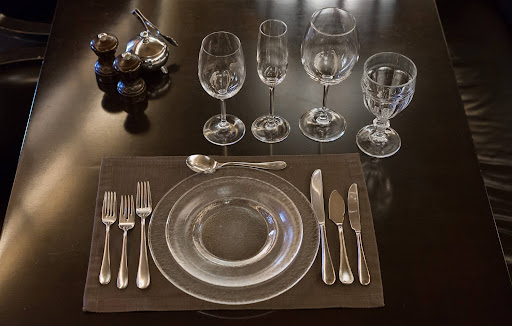
What remains constant across Europe is a sense of balance and order. The table is always arranged precisely: fork on the left, knife on the right, spoon just behind it, and glasses set diagonally on the upper right—for water, wine, and champagne. The napkin goes on the lap right after sitting down, not when the food arrives.
Across Europe, diners never lift the bowl to finish their soup, nor do they cut all their meat at once—only one piece at a time, savoring each bite. One should never raise one’s voice at the table, place elbows on the surface, or gesture with utensils. Such actions violate the norms of proper table etiquette.
Example of Luxury Table Setting for Dining Etiquette
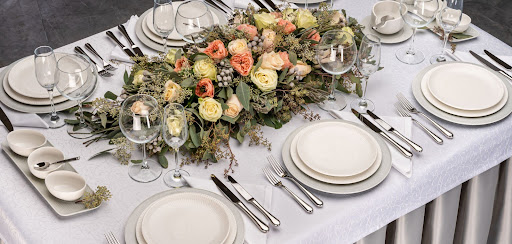
Yes, in a luxury table setting, everything revolves around symmetry, clean lines, and a flawless balance between beauty and comfort. Select your core dinner service in high-quality porcelain or bone china, distinguished by its fine detailing, delicate ornamentation, and harmonious proportions.
The golden rule is layering: the charger plate always comes first, serving as the base for the appetizer or soup dish that follows. Utensils are placed with precision—from the outermost to the innermost—reflecting the sequence of each course in a perfectly balanced setting. Choose glassware made of crystal or high-quality colored glass, using different shapes for each drink. The glasses should be arranged diagonally, from the water glass to the champagne flute.
So here’s the classic expert setup for a four-course luxury dinner, the kind you’ll see at private dinners, fancy restaurants, and formal receptions:
- The first course, of course, begins with the appetizer. Set the entrée plate on the charger to create the first elegant layer of the setting. A suitable option would be the Bernardaud Louvre series or the Puiforcat Cercle d’Orfèvre collection, both known for their refined design language. Next, position the utensils so that the small knife and the delicate, fine-tined fork sit exactly where they should. Appetizers are commonly accompanied by a light wine, so it is advisable to place a tulip-shaped white wine glass.
- According to etiquette, the second course is soup. The appropriate vessel is a deep, wide bowl with minimal or no decoration to maintain visual harmony with the dish’s color. For this course, use dedicated soup spoons. They are typically larger and more rounded, designed to complement the texture and presentation of the dish. Consider flatware from the Puiforcat Normandie or Christofle Aria collections, which are excellent examples. For the second course, water is always served instead of alcohol, placed in a tall glass made of clear crystal.
- The main course serves as the central focus. A large dinner plate is required, possibly featuring a gold trim or a platinum rim, such as Haviland Infini Platinum or Dior Maison Granville. When serving meat, choose a weighty, well-balanced knife that matches the dish. And for fish, always provide the proper set, complete with a refined spatula-shaped fish knife. Wine glasses are set on the table based on the course: a wide balloon glass for red wine or a faceted glass for white.
- The final course is customarily dessert. It is served on a miniature plate from the primary service, or on an alternative piece that maintains stylistic coherence while offering a heightened decorative element. Here, both a spoon and a fork should be placed on the table. Dessert is usually paired with a sweet wine or sparkling wine, served in a dedicated sweet-wine glass or a classic champagne flute.